⚓
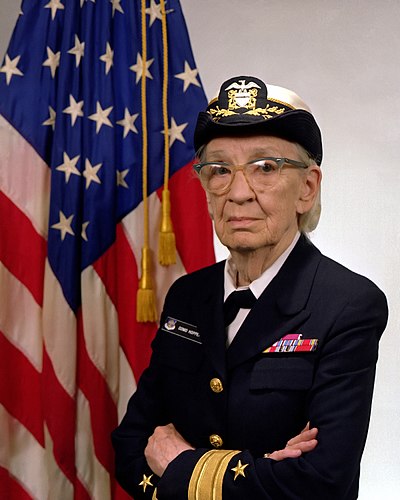
Grace Hopper
Born December 9, 1906 · New York City · Rear Admiral, U.S. Navy & Computing Pioneer
Grace Murray Hopper was a woman who spent her life doing things people told her couldn't be done. She was told computers could not be programmed in English — she proved them wrong. She was told she was too old to serve in the Navy — she served until she was eighty. She was told the idea of a compiler, a program that translates human-readable instructions into machine code, was theoretically impossible — and then she built one. In doing so, she democratized computing, transforming it from an arcane discipline for mathematicians into a tool that accountants, scientists, and businesspeople could use.
Born in New York City on December 9, 1906, Grace Brewster Murray showed an early gift for taking things apart to understand how they worked — at age seven, she disassembled seven alarm clocks before her mother caught her. She earned a PhD in mathematics from Yale in 1934, becoming one of the few women in the country to hold such a degree. She was teaching mathematics at Vassar College when Japan attacked Pearl Harbor in December 1941. At age thirty-four, overweight for military standards and too old for normal enlistment, she sought a waiver and joined the U.S. Navy Reserve.
The Navy sent Hopper to Harvard, where she was assigned to work under Howard Aiken on the Mark I — a massive electromechanical computer that filled a whole room and weighed five tons. Hopper had never programmed before, but she threw herself into it with characteristic intensity. She became the third person ever to program the Mark I and wrote its programming manual. When a moth lodged in a relay and caused a malfunction in 1947, it was Hopper's team that taped it into the logbook with the note "First actual case of bug being found" — coining the terms "bug" and "debugging" that every programmer uses today.
After the war, Hopper joined the Eckert-Mauchly Computer Corporation, where she worked on the UNIVAC I — the first commercial computer in the United States. Here she had her most radical insight. Programming at the time meant writing in machine code or assembly language — strings of numbers and symbols that corresponded directly to the hardware's instruction set. It was tedious, error-prone, and accessible only to people who had internalized the machine's architecture at a granular level. Hopper believed this was unnecessary. If a computer could be programmed at all, she reasoned, it could be programmed to translate English-like instructions into the machine code it required.
Her colleagues told her this was impossible — that computers could only do arithmetic, not linguistics. She ignored them. In 1952, she completed A-0, the world's first compiler: a program that took symbolic mathematical code and translated it automatically into machine-executable instructions. It worked. She later described her approach simply: "I had a running compiler and nobody would touch it. They told me computers could only do arithmetic." The compiler was not just a technical achievement. It was a philosophical shift — an argument that the hard work of translation between human thought and machine execution should be done by the machine, not the programmer.
"The most dangerous phrase in the language is, 'We've always done it this way.'"
Building on the compiler concept, Hopper became the driving force behind COBOL (Common Business-Oriented Language), which was standardized in 1959. COBOL was designed to be readable by non-mathematicians — its syntax resembles plain English — and it became the dominant programming language for business computing for decades. Estimates suggest that more COBOL code exists today than code written in any other language; trillions of dollars of financial transactions still run on COBOL systems every day. Hopper achieved the rank of Rear Admiral in the U.S. Navy — the first woman to hold that rank — before retiring at age seventy-nine. She received the Presidential Medal of Freedom posthumously in 2016.
Born in New York City on December 9.
Earns PhD in mathematics from Yale University.
Joins the Harvard Mark I team — becomes one of the first programmers in history.
Completes A-0, the world's first compiler — translating code into machine instructions.
Leads development of COBOL, the first business-oriented programming language.
Promoted to Rear Admiral by special presidential appointment — the first woman to hold this rank.
Hopper turned programming from a specialist art into a broadly accessible skill. Her compiler concept is the foundation of every high-level programming language in use today — without it, software development would remain confined to a tiny priesthood of machine-code specialists. COBOL, her most enduring creation, still processes the majority of the world's financial transactions. She also broke profound barriers of gender and age in a field and a military that were deeply hostile to both, and she did it not by demanding recognition but by producing work so undeniably excellent that recognition became impossible to withhold.