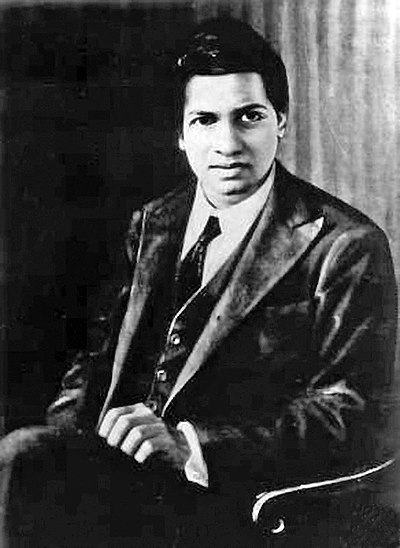
Fast Facts
- Born
- December 22, 1887
- Zodiac
- ♑ Capricorn (Dec 22 – Jan 19)
- Origin
- Erode, Tamil Nadu, India
- Education
- Largely self-taught
- Cambridge
- Trinity College, 1914–1919
- FRS
- Fellow of Royal Society, 1918
- Results
- ~3,900 identities & theorems
- Died
- April 26, 1920, age 32
- Legacy
- Ramanujan Prize; National Mathematics Day
He was twenty-three years old, working as a clerk for the Madras Port Trust on a salary of twenty-five rupees a month, when he mailed a letter to G. H. Hardy at Trinity College, Cambridge. The year was 1913. The letter contained 120 mathematical theorems and formulas, most of them without proof. Hardy, one of the finest mathematicians in the world, sat with the pages for an evening and initially suspected fraud — the results were too extraordinary, too unfamiliar in method, too improbable in origin. Then he reconsidered: no fraud could have invented results this strange and this precisely correct. “They must be true,” Hardy later said, “because, if they were not true, no one would have had the imagination to invent them.” He arranged for Srinivasa Ramanujan to come to Cambridge. What followed changed mathematics.
Ramanujan was born on December 22, 1887, in Erode, a small town in Tamil Nadu, to a Brahmin family of modest means. His father was a clerk in a cloth merchant’s office; the family lived in a cramped house in Kumbakonam. From his earliest years, the boy showed a fixation with numbers that was incomprehensible to those around him. By the time he was ten, he had exhausted his school’s mathematical curriculum. At twelve, he borrowed a copy of S. L. Loney’s trigonometry textbook from a college student, worked through it entirely on his own, and began deriving his own theorems. At fifteen, he obtained G. S. Carr’s “Synopsis of Elementary Results in Pure Mathematics” — a dry compilation of 5,000 theorems with no proofs — and used it as a kind of textbook, working out all the proofs himself. This, essentially, was his entire mathematical education.
Ramanujan won a scholarship to Government Arts College in Kumbakonam but lost it when he neglected every subject except mathematics. He failed his examinations and spent several years in poverty, continuing to fill notebooks with mathematical results while searching for employment. His family arranged his marriage to a nine-year-old girl named Janaki in 1909, adding household pressure to financial strain. He sent his results to three prominent British mathematicians before Hardy — two never replied; the third said he could not understand the work. The letter to Hardy in January 1913 was his last throw.
“An equation for me has no meaning unless it represents a thought of God.”
— Srinivasa RamanujanHardy arranged a scholarship and Ramanujan arrived in Cambridge in April 1914. The collaboration between the two men — Hardy formal, skeptical, trained in the rigorous European tradition; Ramanujan intuitive, unorthodox, proceeding by leaps he sometimes could not fully explain — produced some of the most remarkable mathematics of the twentieth century. Together they proved foundational results about the partition function. Ramanujan made contributions to modular forms, elliptic functions, continued fractions, and highly composite numbers. The Hardy–Ramanujan number, 1,729 — the smallest expressible as a sum of two cubes in two different ways — entered legend during a hospital visit. His notebooks contained results that mathematicians are still verifying a century later.
In 1918, Ramanujan was elected a Fellow of the Royal Society, one of the youngest ever and the first Indian. He was also the first Indian elected Fellow of Trinity College. But the English climate, wartime food shortages, and tuberculosis were destroying him. He returned to India in March 1919 and died on April 26, 1920, aged thirty-two, at a rented house in Chetput, Madras. He left behind three notebooks, and a “lost notebook” rediscovered in 1976, whose full implications are still being explored.
“I have not trodden through the conventional regular course which is followed in a university course, but I am striking out a new path for myself.”
— Srinivasa Ramanujan, letter to G. H. Hardy, 1913The legacy of Ramanujan extends far beyond the individual results. His mock theta functions — described in a letter written from his deathbed — were not understood for nearly eighty years. In 2002, mathematician Ken Ono proved they are components of harmonic Maass forms, with applications to the mathematics of black holes in string theory. India observes National Mathematics Day on December 22, his birthday. The SASTRA Ramanujan Prize is awarded annually to outstanding young mathematicians. In the history of mathematics, there has been no one remotely like him.
Achievement Timeline
Ramanujan vs. the Mathematical World
| Dimension | Ramanujan | Typical Mathematician | Context |
|---|---|---|---|
| Training | Entirely self-taught | PhD + postdoctoral study | No formal advanced education |
| Results produced | ~3,900 identities & theorems | Dozens in a career | Many still unproven at death |
| Age at FRS election | 30 | Typically 50s | One of the youngest ever |
| Method | Intuition & inspiration | Rigorous proof-first | Results arrived “complete” |
| Active years | ~15 years total | 40+ year careers | Died at 32 |
Watch & Learn
The extraordinary story of Ramanujan’s mathematical journey
The Man Who Knew Infinity — film & mathematical legacy
Why Ramanujan Still Matters
Ramanujan’s work continues to reshape active areas of mathematics and physics. His mock theta functions, described in a letter written days before his death, found their modern explanation only in 2002 and now appear in the mathematics of black holes and quantum gravity. His formulas for pi are used in computer programs calculating pi to trillions of digits. His circle method, developed with Hardy, is foundational to analytic number theory. He proved that genius is not a product of institution, privilege, or geography — that the deepest mathematical truth can emerge from any mind that burns brightly enough to find it. For India, he is the supreme symbol of world-class intellectual achievement arising entirely from within its own soil and spirit.

.jpg)

