William Shakespeare
1564 – 1616 · Stratford-upon-Avon, England
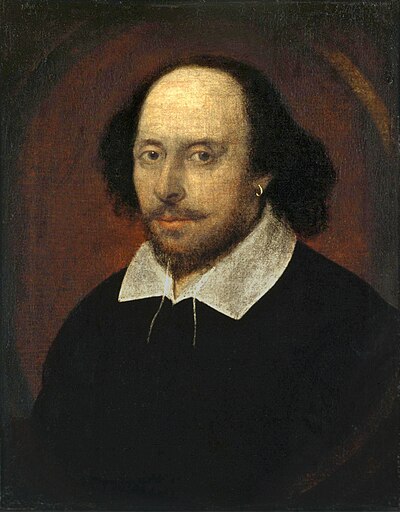
✍
37 Plays · 154 Sonnets · The Globe Theatre
Born in the market town of Stratford-upon-Avon in April 1564, William Shakespeare became the most celebrated writer in the English language — perhaps in any language. The son of a glover and local alderman, he received a solid grammar-school education before leaving for London in his mid-twenties, where the theatres of Elizabethan England were drawing vast crowds hungry for spectacle, poetry, and ideas.
Shakespeare joined the Lord Chamberlain's Men as both actor and playwright, and his rise was swift. By the 1590s he was already producing the comedies — A Midsummer Night's Dream, Much Ado About Nothing — and the history plays that traced England's turbulent past. Then came the great tragedies: Hamlet around 1600, Othello in 1603, King Lear and Macbeth in 1606. In these works Shakespeare excavated the full range of human experience — ambition, jealousy, grief, madness — with a psychological precision that continues to astonish readers four centuries later.
"All the world's a stage, and all the men and women merely players." — As You Like It
What distinguished Shakespeare from his contemporaries was not merely his facility with language, though that was extraordinary: scholars estimate he invented or first recorded some 1,700 words still in everyday use, from "bedroom" to "eyeball" to "swagger." More remarkable was his capacity for empathy — the ability to inhabit characters radically different from himself and render their inner lives with total conviction. Shylock, Iago, Cleopatra, Falstaff — each speaks with a voice so particular that actors and directors have argued over their interpretations for generations.
In 1599 Shakespeare's company built the Globe Theatre on the south bank of the Thames. It held up to 3,000 spectators — groundlings standing in the yard, wealthier patrons seated in covered galleries — and it was here that the great tragedies received their first performances. The theatre burned down in 1613 during a performance of Henry VIII when a theatrical cannon misfired, and though it was rebuilt, the era was ending. Shakespeare had largely retired to Stratford by then, a prosperous gentleman with a coat of arms and the largest house in town.
He died on 23 April 1616, aged 52. Seven years later, two of his fellow actors assembled his plays into the First Folio — without which eighteen plays, including Macbeth and The Tempest, might have been lost forever. That act of preservation gave the world one of its most enduring literary inheritances.
A Midsummer Night's Dream and Romeo and Juliet — the lyrical early comedies and tragedies that established his reputation.
Hamlet premieres — arguably the most performed and discussed play in history, exploring mortality and indecision.
The great tragic period: Othello, King Lear, Macbeth — three incomparable studies of pride, jealousy, and ambition.
The Tempest — widely read as Shakespeare's farewell to the stage, with the magician Prospero laying down his books.
The First Folio published, collecting 36 plays and securing Shakespeare's works for posterity.
Shakespeare's plays have been translated into every major language and are performed more often than those of any other playwright. But his legacy goes beyond the stage. He shaped the very structure of the English language, gave us enduring metaphors for politics and power, and mapped the human psyche in ways that modern psychology still echoes. To read Shakespeare is not to study the past — it is to confront the permanent questions of what it means to be human.